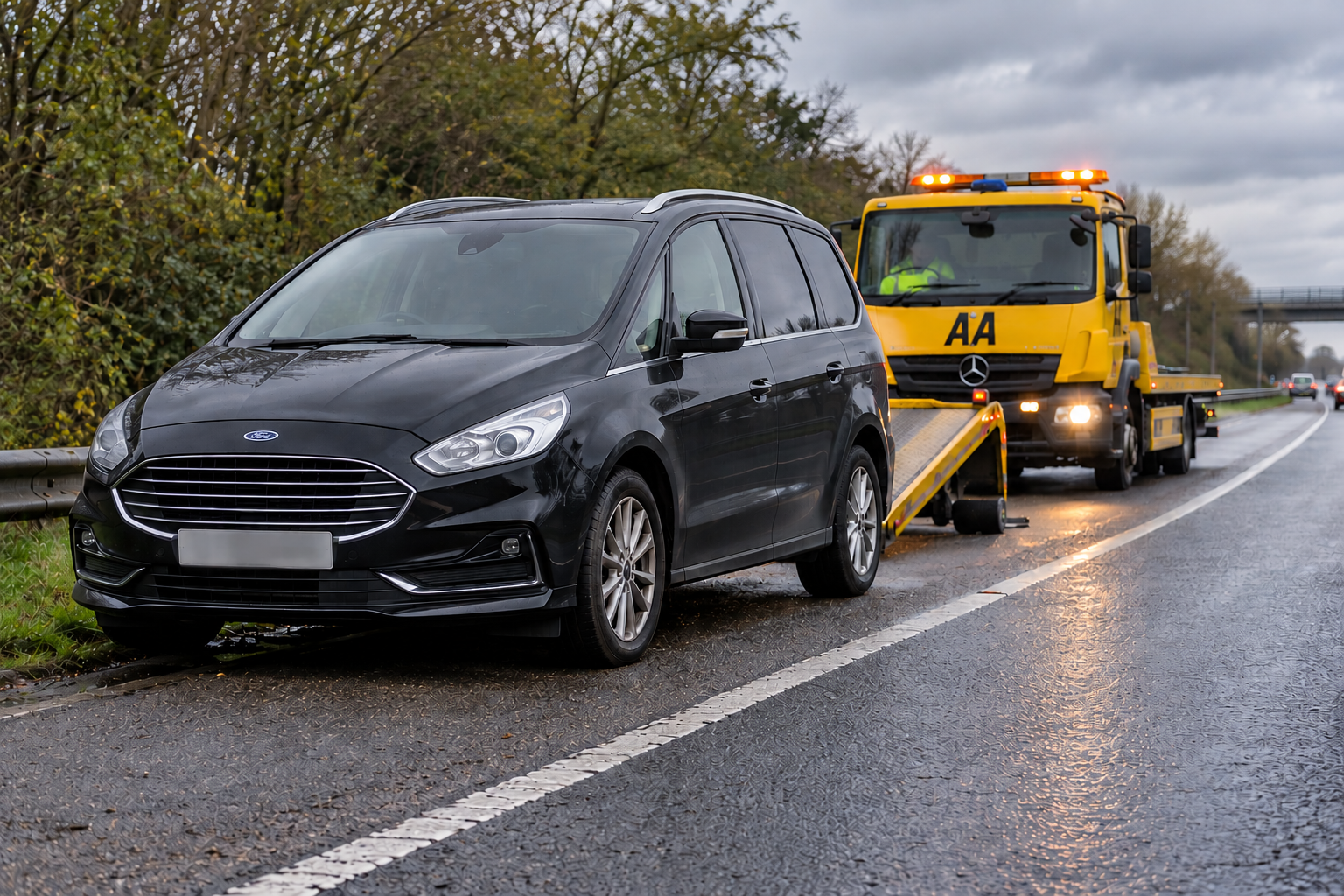
At around 65,000 miles, the automatic transmission in our 2019 Ford Galaxy completely failed.
There had been no transmission warning light, no gearbox error message and no long period of obvious deterioration. One minute we were parking the car. Within minutes, we’d lost drive completely and were waiting for recovery.
Our Galaxy has Ford’s 8F35 eight-speed automatic transmission.
The diagnosis from an independent transmission specialist is not good. The transmission has completely failed and requires a full rebuild or replacement.
The expected cost is almost £5,000 including VAT.
And after researching the 8F35 and speaking to the transmission specialist repairing ours, we’ve discovered we’re certainly not the only Ford owners who have experienced problems with this gearbox.
How our Ford Galaxy transmission failed
Our transmission failure happened very quickly.
We’d had no gearbox warning messages and nothing that made us think the transmission was about to fail.
The first obvious symptom happened while parking. The car suddenly began juddering badly and then wouldn’t go into reverse.
We stopped the car and tried again. Reverse came back and, for a few minutes, the Galaxy appeared to be driving normally again.
Then, at a roundabout shortly afterwards, we suddenly lost power. Pressing the accelerator didn’t produce the expected drive and the car felt as though it had dropped into neutral.
That was effectively the end of the journey.
We were recovered and the Galaxy was taken to a Ford garage.
What did Ford say was wrong?
Ford carried out a visual inspection but didn’t dismantle the transmission for a further look. At this point, we didn’t definitely know that the transmission was the issue, just that the car was not driving.
We received a video inspection of the car and an itemised estimate. Ford’s proposed solution was to replace the transmission, at a cost of around £7,000.
That’s a fairly horrifying figure for a car with only around 65,000 miles on the clock.
Rather than authorising the work, we had the Galaxy moved to an independent transmission specialist for a more detailed assessment. We weren’t ready to part with £7k when we hadn’t actually had confirmation that the transmission had failed.
The diagnosis: complete 8F35 transmission failure
The specialist inspected the Galaxy and confirmed that the 8F35 transmission has completely failed.
This isn’t a minor sensor problem or something that can be solved with a software update. We’re looking at a full rebuild or replacement.
The cost is for repair is almost £5,000 once VAT is included.
That’s significantly less than Ford’s approximately £7,000 quote, but it’s still an enormous repair bill for us, particularly on a car that hasn’t yet reached 70,000 miles, and that we’ve only owned for two and a half years.
What is the Ford 8F35 transmission?
The 8F35 is an eight-speed automatic transmission used across a number of Ford vehicles.
Ford introduced a new eight-speed automatic to the European Galaxy and S-Max range in 2018, paired with its 2.0-litre EcoBlue diesel engines and operated using the rotary gear selector. At the time, Ford said the transmission had been engineered to improve efficiency while providing responsive performance and smooth, swift gear changes.
We started looking into other Ford owners’ experiences of the 8F35 8 speed transmission.
There are numerous anecdotal reports online of owners experiencing 8F35 problems, including some reporting serious failures at surprisingly low mileages. We’ve found owner accounts describing problems from around 35,000 miles.
Owner forums can’t tell us how frequently 8F35 transmissions actually fail, so I don’t think it would be accurate to claim that every 8F35 is destined for an early failure or to put a failure rate on the gearbox. However, the two transmission specialists we spoke to whilst gathering quotes for repair both said that it is not uncommon to see issues with this gearbox, usually around the sort of mileage that our car has done.
Our transmission specialist has another Ford Galaxy with the same problem
Ours isn’t currently the only Ford Galaxy they have in with an 8F35 transmission failure.
As the transmission specialist was giving us their verdict on our gearbox, he said they have another Galaxy on it’s way to them after being recovered on the motorway. That car made it to around 100,000 miles before its transmission failed.
That’s anecdotal too. Two cars in one day at the same transmission workshop with the same Ford transmission issue don’t establish how common the problem is. But at the same time, it’s not the best PR for the 8F35 transmission.
Did we have any warning that the transmission was failing?
Not really.
This is perhaps the part of our experience that I think will be most useful to other Ford owners.
We didn’t spend months driving around with a slipping gearbox or persistent transmission warning messages.
The sequence was basically:
- The car began juddering badly while parking.
- Reverse stopped working.
- Reverse then started working again.
- We drove away.
- Within minutes, the car lost drive at a roundabout.
- The transmission was subsequently diagnosed as having completely failed.
If your Ford automatic suddenly starts juddering or refuses to engage reverse, I wouldn’t assume that the fact it starts working again means the problem has gone away.
Knowing what we know now, we certainly wouldn’t have continued driving ours.
Would changing the transmission fluid have prevented it?
This was one of the questions we specifically asked the transmission specialist.
There’s a lot of discussion online about whether changing automatic transmission fluid more frequently can prevent gearbox problems or extend the life of a transmission.
There’s conflicting advice online about how frequently the fluid in Ford automatic transmissions should be changed, with recommendations of around 30,000 miles often mentioned. Ford’s own maintenance information for the 2019 Galaxy/S-Max, however, lists an automatic transmission fluid change at 150,000 miles (240,000 km).
Indeed, when we were shopping for our Galaxy and went to check one out in a showroom, Ford salespeople specifically described the new eight-speed automatic to us as a “lifetime gearbox”. We were told it was a closed system that wouldn’t need routine servicing. Having already experienced a transmission failure in our previous Ford S-Max, this was something we specifically asked about, and those reassurances played a part in our decision to trust Ford and buy another automatic.
The idea of a “lifetime” or “sealed-for-life” transmission is controversial among owners and transmission specialists. One criticism you’ll frequently see online is that “lifetime” doesn’t necessarily mean the lifetime of the car, and that by the time transmission problems develop, the vehicle may already be outside its manufacturer’s warranty.
In our case, there’s an obvious contradiction that’s difficult to ignore: Ford’s own maintenance information puts the routine fluid change at 150,000 miles, yet our transmission completely failed at around 65,000 miles, less than halfway to that interval.
More importantly, we asked the transmission specialist repairing our car whether changing the fluid more frequently would have prevented this failure.
In their opinion, it would not. Their assessment, based on their experience of repairing these transmissions, is that the build quality of the 8F35 is poor. They told us that changing the transmission fluid more frequently may help extend the life of the gearbox, but fluid changes aren’t a cure for the underlying weakness.
That being said, knowing what we now know, I would definitely be doing a transmission fluid change approximately every 30,000 miles, just for that peace of mind that you’ve done everything you can.
Will Ford contribute towards the repair?
We contacted Ford UK because we don’t think a complete transmission failure at around 65,000 miles is something we’d reasonably expect from the car.
Ford declined to make a goodwill contribution towards the repair.
We were told that the 7 year old car was considered too old for goodwill assistance and that its relatively low mileage didn’t change that decision.
What should you do if your Ford automatic starts juddering or won’t go into reverse?
Our experience with the 8F35 isn’t a diagnosis for somebody else’s car. Juddering, delayed engagement or failure to select reverse can have different causes.
But based purely on what happened to us, I would take any sudden change in an automatic transmission’s behaviour seriously.
In particular, if the car suddenly judders badly, won’t engage reverse or appears to lose drive, I wouldn’t continue driving simply because the problem temporarily disappears.
Getting the car recovered to a transmission specialist may be inconvenient, but after watching ours go from its first obvious symptom to losing drive within minutes, that’s what we’d do if it happened again.
What happens next?
Our Galaxy now needs its 8F35 transmission rebuilt or replaced, with the final bill expected to be close to £5,000 including VAT.
Unfortunately, there’s another part to this story too.
This isn’t our first Ford transmission failure. Our previous Ford S-Max also suffered a complete transmission failure before reaching 70,000 miles. That car had a different PowerShift transmission, so the two failures shouldn’t be conflated. You can read our Ford Powershift transmission problems story here.
But it does mean we’ve now experienced two Ford transmission failures in four years, both before 70,000 miles.
I’ve written separately about why we chose to trust Ford again after the first failure, and why we won’t be doing it a third time.